ProSal vs. Straight Production: Which Compensation Model Actually Pays New Vet Grads More (And Which One Burns Them)
ProSal vs. straight production for new-grad vets: the AVMA data, the negative-accrual trap, and which model fits your practice. Includes a 10-minute checklist.
You're three weeks out from graduation, the offer landed in your inbox last night, and there's a line halfway down page four that says "ProSal compensation, 22% of net collections, $9,500 monthly draw." You half-remember someone in clinics mentioning negative accrual and you have no idea whether 22% is generous or insulting. Your classmate took straight production at a different practice and swears it's the smarter play. So which one actually pays a new associate more — and which one quietly turns into a debt trap by month six?
The 60-second definition of each model
Both models pay you a percentage of what you produce — the difference is what happens in the gap.
ProSal (production plus salary) is a guaranteed monthly base — call it your draw — plus a percentage of what you produce. At the end of each month the practice reconciles: if your production-based pay exceeded the draw, you get the difference. If it didn't, you keep the draw (sometimes) or owe it back (often — see the negative accrual section).
Straight production is a pure percentage. No floor. Produce $10,000 in a slow month at a 22% rate, you get $2,200. The practice owes you nothing else.
Both models talk about "production" but mean different things. Gross production is what you bill — every service you charge for. Net collections is what the practice actually receives after insurance write-offs, refunds, client discounts, and bad debt. A contract that says "22% of net collections after pharmacy costs" is paying you on a much smaller number than 22% of gross production. Read your offer carefully: is the percentage applied to production or collections, is it net or gross, and which costs are deducted before the math happens. Three pages can hide three different answers.
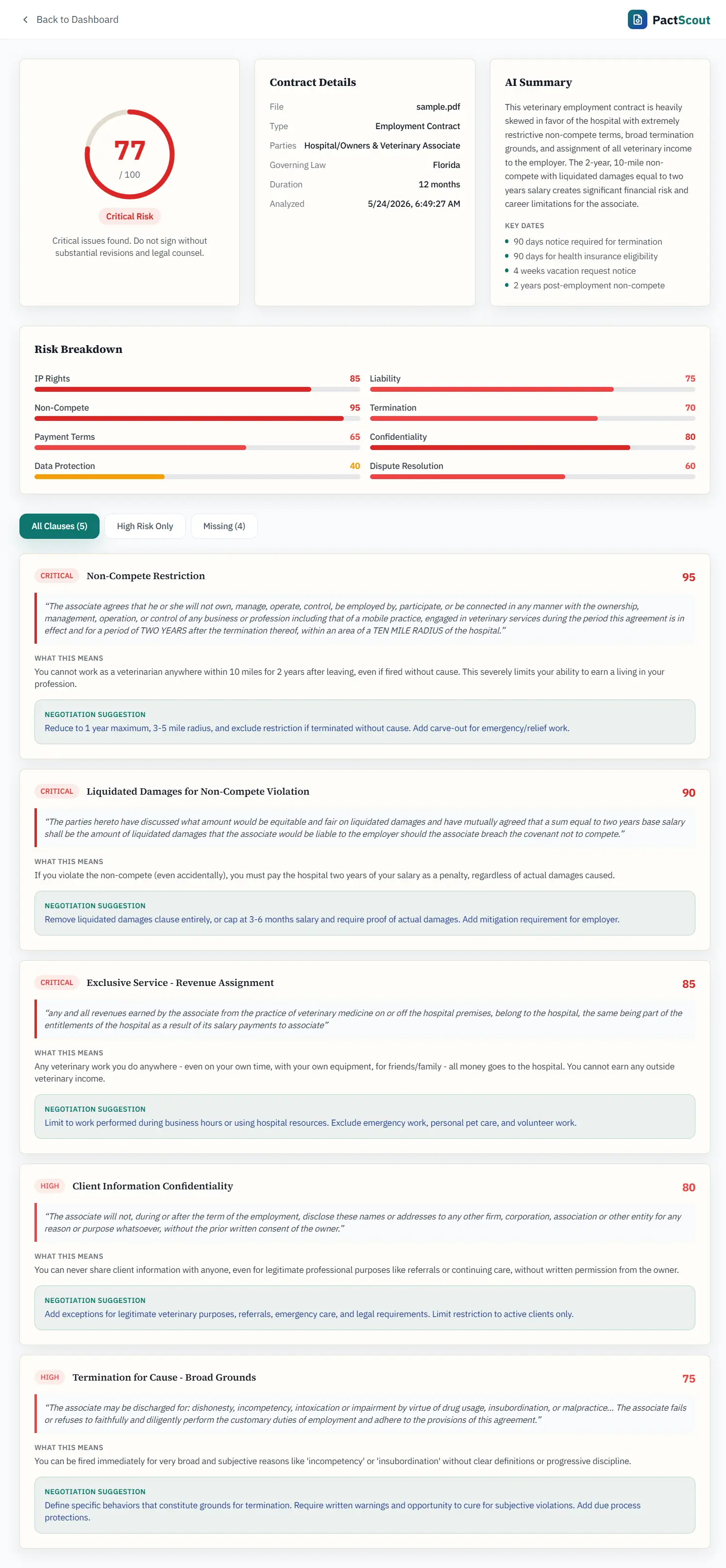
If your offer has a ProSal clause and you're not sure what you're looking at, run it through PactScout's free first scan — we flag the negative accrual language and production definition in under 90 seconds.
What new grads actually earn under each
The honest numbers from AVMA 2024 compensation reporting show straight production at the top, ProSal in the middle, salary-only at the bottom for new clinical-practice grads: [VERIFY: pull exact figures from AVMA chart-of-the-month — secondary reporting cites salary $121,640 / ProSal $159,733 / production $169,809].
Two things in that data are worth pausing on. First, [VERIFY: AVMA] roughly 70% of 2024 new clinical-practice grads took ProSal compared with 29% on salary-only. ProSal is the default in corporate practices and most mid-sized private GPs because it's a compromise that gives the new grad some predictability while keeping practice owners aligned with associate productivity.
Second, the gap between ProSal and straight production averages about $10,000 — which is real money but smaller than the gap between salary-only and either production-based model. If you're choosing between a guaranteed salary and ProSal, the production exposure is worth a lot (around $38K on average). If you're choosing between ProSal and straight production, you're trading downside protection for roughly $10K of upside.
The average matters less than the variance. Straight production has a much wider distribution: the top quartile earns substantially more than ProSal, and the bottom quartile earns substantially less. If your first year is slow — and for most new grads it is — straight production can pay you below salary-only. For context on starting offers, VIN has tracked new-grad averages around $130K with 61% receiving signing bonuses, but those are headline numbers — the structure underneath them is what determines your take-home.
The negative accrual trap
This is the single biggest landmine in a ProSal contract and the reason most attorneys reviewing vet contracts spend half their time on this one paragraph. dvm360 has covered this directly.
Here's how it works. Your contract guarantees a $9,500 monthly draw. Month one you produce $35,000 at 22% = $7,700 in production-based pay. The practice still pays the $9,500 draw. You're now $1,800 in the hole.
Month two you produce $50,000 at 22% = $11,000. Under a clean contract you'd get the $11,000 (or $9,500 floor plus the difference). Under a contract with negative accrual, the practice deducts the $1,800 deficit from month one before paying you. You take home $9,200.
That's fine — until it isn't. If the deficit grows month after month, which it can during your ramp period, vacation, holidays, slow seasons, or any month a major piece of equipment breaks, you can end up owing the practice money. Unlimited or indefinite negative accrual — where the practice can claw back deficits across the entire term of your contract — means you can leave the job after a year and discover you owe them five figures.
The fix isn't to refuse negative accrual entirely. Almost every ProSal contract has it. The fix is to cap it. Industry guidance from veterinary contract attorneys (see Chelle Law's breakdown of production pay) is a 90-to-180-day rolling cap [VERIFY: confirm Chelle Law's specific recommendation], meaning the deficit resets after 3-6 months so a slow Q1 doesn't follow you into Q4. Anything beyond 180 days, or anything that lets deficits roll into year two, is aggressive. Roasa Law's 2025 year-in-review flagged production-definition and negative-accrual language as among the most common issues in the contracts they reviewed [VERIFY: cite Roasa Law's specific 2025 finding once you read their full post].
Read your contract specifically for: does negative accrual reset on a calendar basis (monthly, quarterly, annually)? Does it survive termination — meaning leaving the job can trigger an invoice? And is there a cap on the total deficit you can carry at any one time?
Why 22% sounds great but might not be
The percentage is the most visible number in any production-based offer. It's also the easiest one to make look generous while quietly shrinking what it applies to.
Walk through what the percentage is applied to. A contract that pays 22% of gross production is one thing. A contract that pays 22% of net collections after a long list of deductions is another. Common deductions to look for:
- Insurance write-offs and adjustments
- Client discounts (senior, multi-pet, package deals)
- Refunds and bad debt
- Lab fees passed through to clients
- Pharmacy costs, in-house and online prescriptions
- External referral fees
- Equipment usage fees for advanced diagnostics (MRI, CT)
A 22% rate on "net collections after pharmacy and lab pass-through" can easily pay less than 18% on gross production. The headline rate went up; the number it's applied to shrunk faster. Language to watch for reads something like this:
"Associate compensation shall equal twenty-two percent (22%) of net collections, defined as gross production less write-offs, refunds, discounts, and the cost of pharmacy, laboratory, and outside services rendered through third parties."
This kind of clause is normal — the question is which deductions are reasonable (insurance write-offs, true bad debt) and which are extraction (passing pharmacy markup costs through to your percentage when the practice still profits on the inventory). Before signing, build a quick model: take a realistic month of expected production, apply each listed deduction, then apply your percentage. The actual dollar number is what you're agreeing to. The headline rate isn't.
The 90-day question every new grad should ask
A new graduate doing wellness exams, vaccines, and basic GP work takes 9 to 14 months to ramp up to experienced-doctor production. You are slower at surgeries, slower at workups, you ask more questions, you double-check more often. This is correct and necessary — and it's also the reason your production numbers in months one through six will look lower than the senior doctors in the same practice.
If your contract reconciles monthly with no ramp-up grace period — meaning your draw versus production gets settled every 30 days starting day one — you will be in negative accrual territory for most of your first year, even at a reasonable rate, even at a busy practice.
Three things to look for as protections. A guarantee period, typically 12 months, during which the draw is locked and any deficit is forgiven or capped — sometimes called "ramp protection" or a "guarantee year." A graduated production target, where the percentage rate scales up as you do or the threshold the practice expects from you increases over time. A mentorship credit, where production attributable to your mentor's cases or your training time isn't counted against your numbers.
If your contract has none of these and reconciles monthly from day one with full negative accrual, you're absorbing the entire ramp-period risk. That's not new-grad-friendly; that's practice-friendly.
Five clauses to redline before you sign either contract
These are the five paragraphs that decide whether your contract is fair or extractive. Negotiate them before signing — once you've signed, you've signed.
- Negative accrual cap. A 90-to-180-day rolling cap, with deficits that do not survive termination. Anything longer or open-ended is a problem.
- Production definition in writing. Specifically: is the percentage applied to gross production or net collections? Which deductions are included? Get specific dollar examples in writing where possible.
- Retroactive adjustment limits. Some contracts let the practice "true up" past production calculations if billing errors are discovered later. Cap this — for example, no retroactive adjustments more than 60 days after the relevant pay period.
- Guarantee duration. A minimum 12-month guarantee year where the draw is locked and deficits are forgiven or capped during your ramp. Six months is too short for GP wellness-heavy roles.
- Chargeback documentation requirements. If the practice claws back production for refunds, write-offs, or returned services, you should have the right to see the documentation. "Chargebacks at the practice's discretion" is a blank check.
When straight production is actually the right call
Straight production isn't a trap. It's the wrong fit for some practice types and the right fit for others.
It works for high-volume practices where the schedule is full from day one and ramp time is short — ER, surgery-heavy specialty practices, busy urban GPs with established client demand. In those settings, production-based pay rewards efficiency and you'll likely beat ProSal averages within months. AEGD-trained or internship-trained associates moving into specialty roles often do better on straight production for the same reason.
It's the wrong call for GP wellness-heavy roles, rural single-doctor practices, or any setting where a new grad is the first doctor on the schedule with no built-in caseload. In those settings, you're not the production constraint — the appointment book is. Straight production turns market risk into your risk.
Ask the practice what their last associate's first-year production looked like. If they can't or won't tell you, that's data. A practice that's hired multiple new grads on straight production knows the numbers cold and shares them.
The 10-minute test before you sign
Run your offer through this list. If you can't answer any of these from the contract text — not from a verbal answer from the practice owner — you're not done reviewing.
- Is the percentage applied to gross production or net collections?
- What specific items are deducted before the percentage is applied?
- Is there negative accrual? If yes, how is it capped and when does it reset?
- Does negative accrual survive termination?
- Is there a guarantee period? How long?
- Is there a sign-on clawback? Over what period and prorated how?
- How long is the non-compete, what's the geographic radius, and what's the governing-law clause?
- What's the malpractice tail coverage situation — claims-made or occurrence? Who pays the tail premium if you leave?
- Are there retroactive production adjustments? Capped how?
- Can you see your production reports and chargeback documentation on request?
If any answer is "the contract doesn't say" or "we'll figure it out later," that answer is the problem.
An attorney review of a ProSal contract runs $300–$1,000 and takes a week. PactScout's full report is $49 and turns around in minutes — built specifically for new-grad vet contracts. Scan yours at pactscout.com/vet before you sign.
PactScout is a screening tool, not legal advice. For high-stakes negotiation, talk to a contract attorney.
Don't sign your next contract blind
Upload any contract to PactScout and get instant risk scoring, clause-by-clause analysis, and negotiation suggestions — free.